The mHealth industry is in full swing and now there are more than 350,000 apps for digital health accessible to users in the App Stores. There are many applications for mobile medical that serve different uses, including medical data analysis, appointment scheduling, Telemedicine, appointment booking, and even meditation. Yes the field of healthcare is expanding exponentially by leaps and leaps.
With this variety the possibilities are endless. You can make use of your device not just to track the amount of calories consumed however, you can also get assistance from a medical professional or to predict health illnesses.
If you’re looking for an idea for a healthcare app to help future development of healthcare apps then you’re in the right spot. Here are the top medical apps that are available to doctors and patients, along with examples. We also provide instructions on how to ensure that the app is in line with the most important regulations around the world.
But first, let’s take a quick look at the healthcare apps market and healthcare providers.
Mobile apps for healthcare revolutionize the way that patients receive medical care and track their medical health. The development of a health app evolves in line with.
The statistics show that there are over 325 000 health-related mobile apps for health accessible on app marketplaces.
Statista says that in 2020, the health app market is predicted to grow to 60 billion U.S. dollars.
60 percent of smartphone users downloaded an mHealth app on their device.
For mobile apps for healthcare trends, fitness apps for mobile phones are the most popular among Android users (39 percent of downloads)
however iOS users prefer health-oriented medical apps (62 percent of downloads) and are easy to use with the Apple Watch.
In the same way mobile healthcare apps have also improved the efficiency of medical staff as well as clinicians. They could save around $200 billion in remote monitoring of patients.
Now that you’re well-informed about the primary trends in the market for mHealth apps and statistics, let’s learn more about the process of development so that you are able to design an app that is a health-related one.
When deciding on the top healthcare development company, take into account past projects, reviews from clients as well as the company’s technological experience. Creating a healthcare app is a task that could take longer than a month. Therefore, it’s crucial for both the developer and customer to be comfortable.
Complete the contact form to arrange meetings with a manager of business development to discuss the details of your venture.
Based on the project’s specifics and the project’s details, a business analyst, project manager, and solution architect will come up with rough estimates for your project. They will then send the estimate to you.
If you are able to agree with the initial estimate the healthcare app developers will go over the details of your application to develop sketches, user narratives and wireframes.
Once you have agreed on all the deliverables that are part of the initial phase The group (tech stack) will begin the developing mobile applications for healthcare through iteration.
There are many medical apps that are targeted towards various users, such as healthcare professionals, labs and patients. Their capabilities are affected, as are their integrations, and the degree of data security needed. Let’s take a look at the most popular healthcare applications.
Designed for medical professionals, they contain patient details, such as names as well as dates of birth, and insurance details, like addresses, etc. So, when you begin your medical professional’s development process it is crucial to ensure that your application is HIPAA compatible and has a particular attention to the encryption of personal data to protect against data security data breaches. Medical professionals can utilize mHealth applications.
These health apps were created to enhance clinical decision-making and interaction with medical specialists at the hospital of a specific. They can be used for voice and messaging chat, as well as file sharing as well as electronic health records.
This kind of app improves customer satisfaction of customers as well as loyalty and health outcomes, and offers greater transparency between patients and doctors.
These apps make it easier to update medical records of patients, such as medical visits, blood pressure exams, prescriptions, and other details to track the progress of a patient.
The health apps can be integrated into Electronic Health Records (EHR) as well as wearable devices, which permits monitoring health issues in real-time and tracking heart rate and identifying those at risk. In order to build an application for risk assessment on mobile the developers typically employ machine learning to aid in pattern recognition, like we used for our latest project, which was a facial cancer neural network.
Barcode scanning applications in the field of healthcare permit scanning medical records electronically and medication barcodes by using an integrated camera on mobile devices, which can save money on barcode scanners.
These applications are utilized by doctors to calculate individual doses of medicines according to the patient’s weight, age and other information about the patient and avoid calculations manually, spreadsheets and other sophisticated instruments.
The industry of mobile healthcare that focuses on patients is divided into two categories: wellness and medical. Below, we will highlight each kind of medical app that falls under both groups as well as their specific examples and crucial features.
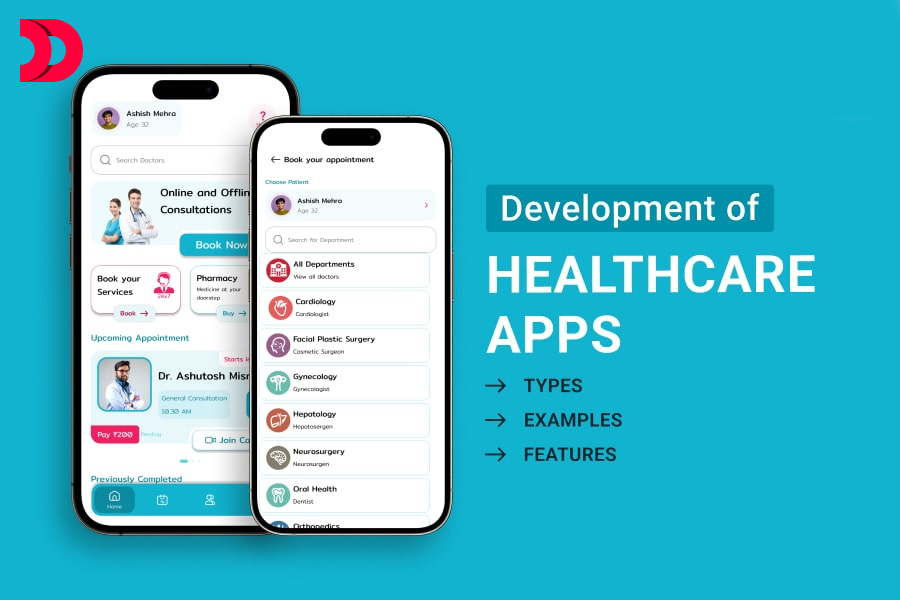
In a hectic environment patients can get advice and treatment from medical professionals using telemedicine apps that allow them to access their office or their homes. The mobile health app enables patients to find a medical professional from a list of doctors, schedule an appointment, then participate in it through video calls and then pay for the visit through an integrated payment gateway.
The apps for health can help users stay healthy by keeping track of their daily activity and weight, the number of calories burned, lists of workout programs, as well as the integration of wearables with. In our previous article, which was devoted to fitness app development we discussed the other features that these apps offer and also provided you with detailed instructions on how to create one.
If you are planning to create an app for mobile medicine it is important to think about security regulations and compliances in various countries that are mostly focused on the safety of patient data. If your app is not compliant with the requirements, no matter the quality of the health app you have created it will be removed from marketplaces for apps.
The best part is that if you develop an application for diet, calories count or meditation application and you don’t have to create it in compliance with. If you are developing other mobile apps which deal with patient’s health information, as well as other sensitive personal information should be considered the following guidelines to ensure that medical information safe from being hacked:
The rule compels health app developers to secure not just app security from other parties, but also sensitive patient data stored on mobile devices or communicated via big data transmission.
This rule mandates that any health-related information, such as the availability of health care or the payment for health insurance, health care plans, or any other information that may be linked to a specific person, be kept private and secure from the prying eyes of third parties.
The law incorporates increased privacy and security regulations imposed by HIPAA, as well as holding business partners and service healthcare providers liable for exposing infractions. The law seeks to address security and privacy concerns associated with the electronic transfer of health information.
To launch your mHealth application in the European market, you must provide users with the capacity to safeguard and control their personal data in regard to its processing.
This directive safeguards the rights and liberties of individuals in relation to information processing involving personal information as well as the transfer of free data.
The Data Protection Act (DPA) is a United Kingdom Parliamentary Act that governs how organizations, businesses, and the government utilize personal data. It protects individuals and establishes guidelines for how personal information can be used.
The law regulates how private-sector organizations collect, utilize and share personal information when conducting business. However, it stipulates that individuals are entitled to access their personal information that is held by any company or business and have the ability to contest the accuracy of their data. Securely guarding personal data.
There are numerous types of mHealth applications aimed at various users. If you’re planning to create a healthcare-related application, it is important to take into account the user’s needs, as it will affect the quantity of features available, and also the regulations you need to be considered. If you’re looking for an app development company for healthcare, firm, and would like more advice, or calculate the price of the app, drop us a message.